Fiber laser solutions engineered for your application. Request a technical consultation

IPG Photonics Fiber Laser Technology

Three decades of continuous innovation in fiber laser architecture, from the fundamental physics of rare-earth-doped optical fibers to the engineering of industrial-grade beam delivery systems that define the state of the art.

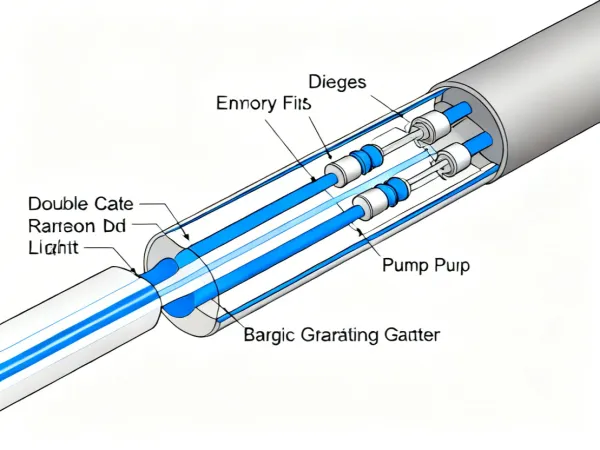
Fiber laser architecture showing double-clad fiber and pump diode coupling
Fundamental Technology

How Fiber Lasers Generate Light

Unlike conventional solid-state or gas lasers, a fiber laser generates and amplifies light entirely within a rare-earth-doped optical fiber. High-brightness semiconductor pump diodes inject energy into the fiber's cladding, which propagates into the doped core where stimulated emission occurs at the desired wavelength.

This all-fiber architecture eliminates the free-space resonator cavities, alignment-sensitive mirrors, and consumable gas fills required by CO2 and lamp-pumped Nd:YAG systems. The result is a laser source with inherent single-mode beam quality, no consumable components, and exceptional thermal management due to the fiber's high surface-area-to-volume ratio.

Note: While IPG's standard industrial fiber lasers operate at 1.07 micrometers (ytterbium-doped), the company also produces erbium, thulium, and holmium-doped fibers for specialized wavelengths. Each dopant material introduces specific tradeoffs in output power, wavelength, and beam quality that must be matched to the application.

Vertical Integration: From Diode to Delivered Beam

IPG is the only fiber laser manufacturer that controls every critical component in the supply chain, from semiconductor pump diodes through specialty optical fibers to beam delivery optics.

01

Pump Diodes

Proprietary high-brightness semiconductor diodes manufactured in-house with rated lifetimes exceeding 100,000 hours. Epitaxial growth, wafer processing, and burn-in testing are all performed at IPG facilities.

02

Specialty Fibers

Double-clad active and passive optical fibers drawn from custom preforms with precisely controlled refractive index profiles. Fiber composition and geometry are optimized per application wavelength and power level.

03

Laser Modules

Single-module outputs from watts to multi-kilowatts, assembled with proprietary fiber-to-fiber combiners for coherent and incoherent beam combining at powers up to 120kW.

04

Beam Delivery

Processing heads, beam switches, and fiber-to-fiber couplers designed for the specific beam parameters of each laser source. In-house optical coating capabilities ensure component compatibility and longevity.

Technical Capabilities

Beam Quality

M² < 1.1 (Single-Mode)

IPG single-mode fiber lasers achieve diffraction-limited beam quality (M² < 1.1), enabling the smallest achievable focused spot sizes for a given wavelength and optic configuration. This is a fundamental physical advantage of the waveguide architecture: the single-mode fiber core acts as a spatial filter, producing a Gaussian beam profile that maintains quality through the delivery fiber and processing optics.

Limitation: Multi-kilowatt single-mode operation is constrained by nonlinear effects (stimulated Raman and Brillouin scattering) in the fiber. Powers above approximately 10kW require multi-mode or beam-combined architectures that trade some beam quality (typically M² 2-6) for higher output.

Electro-Optical Efficiency

>50% Wall-Plug

The direct semiconductor-to-fiber pumping scheme eliminates the multi-stage energy conversion losses inherent in CO2 (RF excitation of gas) and lamp-pumped solid-state (broadband lamp to narrow absorption band) lasers. IPG's ytterbium-doped fiber lasers achieve wall-plug efficiencies exceeding 50%, compared to 10-15% for CO2 and 3-5% for lamp-pumped Nd:YAG systems.

Context: Wall-plug efficiency measures total electrical input to optical output. Actual process efficiency also depends on beam-material coupling, which varies by wavelength, material, and surface condition. The 1.07µm fiber laser wavelength couples well into metals but less efficiently into organic materials compared to the 10.6µm CO2 wavelength.

Genesis Beam Shaping

Dynamic Profile Control

IPG's Genesis fiber laser architecture integrates programmable beam shaping directly within the laser source, enabling dynamic adjustment of the beam intensity profile during processing. This eliminates the need for external beam shaping optics and allows a single laser to optimize its beam profile for different process phases (e.g., piercing versus cutting) within the same production cycle.

Current status: Genesis beam shaping is available in select power ranges and is being expanded across the product line. The range of achievable beam profiles and the speed of profile switching are determined by the specific fiber and combiner geometry, which varies by model.

Power Scaling

Watts to 120kW

IPG's modular architecture enables power scaling from single-watt sources for micro-processing to 120kW multi-module platforms for heavy-section cutting and welding. Incoherent beam combining through proprietary fiber-to-fiber couplers allows individual laser modules to be added incrementally, providing a clear upgrade path as processing requirements evolve.

Practical consideration: Higher power does not always produce better results. The optimal laser power for a given application depends on material thickness, processing speed, assist gas dynamics, and heat-affected zone tolerances. IPG's application laboratories help determine the minimum power configuration that meets process specifications.

Laser Technology Comparison: Fiber vs. CO2 vs. Nd:YAG

Each laser technology has distinct advantages depending on your material, thickness, and quality requirements. This comparison uses industry-standard specifications to help you evaluate which technology best fits your application.

Parameter Fiber Laser (Yb-doped) CO2 Laser Lamp-Pumped Nd:YAG
Wavelength 1.07 µm 10.6 µm 1.064 µm
Wall-Plug Efficiency 50-55% 10-15% 3-5%
Beam Quality (M²) <1.1 (single-mode) 1.1-1.3 (typical) 10-25 (multimode)
Available CW Power Range 1W - 120kW 10W - 20kW 10W - 6kW
Metal Absorption (steel) High (35-40% at 1.07µm) Low (5-10% at 10.6µm, requires higher power) High (35-40% at 1.064µm)
Organic Material Processing Limited (poor absorption in most organics) Excellent (high absorption in wood, acrylic, textiles) Limited
Maintenance Requirements Minimal (no optics alignment, no gas refills) Regular (mirror alignment, gas refills every 6-12 months) High (lamp replacement every 500-1000 hrs)
Source Lifetime >100,000 hrs (diode rated) ~20,000 hrs (tube refill cycle) 500-1,000 hrs (lamp life)
Typical Capital Cost (6kW) $80,000 - $150,000 (source only) $50,000 - $100,000 (source only) $30,000 - $70,000 (source only)
5-Year Total Cost of Ownership Lower (energy savings offset higher capital) Higher (gas, mirrors, electricity costs accumulate) Highest (frequent lamp replacement + low efficiency)

Source: Specifications reflect typical values based on published manufacturer datasheets and IPG internal test data as of 2024. Actual performance varies by specific model, configuration, and application conditions. Capital cost estimates are for laser source modules only and do not include system integration, motion platforms, or enclosures. CO2 pricing based on RF-excited slab laser configurations.

1,400+
Engineers in R&D

Continuous Investment in Fiber Laser Science

IPG maintains one of the largest dedicated fiber laser R&D organizations in the industry, with over 1,400 engineers focused on advancing pump diode technology, fiber design, beam delivery optics, and application process development across facilities in the United States, Germany, and Russia.

1994 First commercial erbium fiber amplifier for telecommunications
2000 Kilowatt-class industrial fiber laser changes metal processing
2013 $800M annual revenue (IPGP SEC 10-K filing) as fiber lasers displace CO2 across manufacturing
2018 LightWELD handheld laser welding platform launched
2023 Genesis architecture with integrated beam shaping unveiled

Explore How IPG Fiber Laser Technology Can Improve Your Process

Whether you are evaluating a transition from CO2 or solid-state lasers, scaling an existing fiber laser process, or investigating a new application, IPG's application laboratories (located in Oxford MA, Burbach Germany, and Beijing China) offer free feasibility testing. The standard evaluation includes: material compatibility assessment with your specific alloy grades, process parameter optimization across power, speed, and focal position variables, metallographic cross-section analysis of cut/weld quality, and a documented report with cycle time and throughput projections for your production volumes.