Fiber laser solutions engineered for your application. Request a technical consultation

IPG Photonics Industry Solutions

Fiber laser technology engineered for the specific material processing demands of your industry. From automotive body-in-white to medical device micro-processing, IPG delivers validated, production-ready solutions.

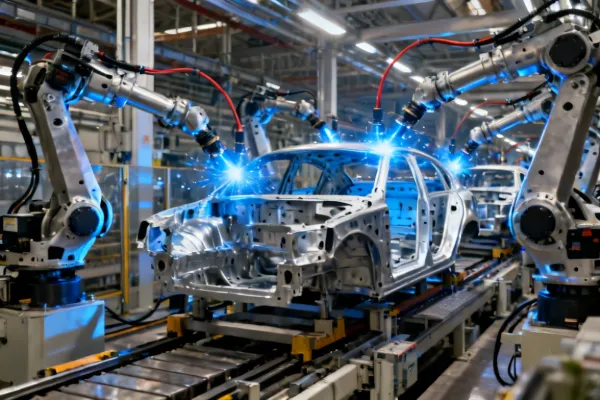
Fiber laser welding in automotive body-in-white production
Industry Solution

Automotive Manufacturing

Modern automotive body-in-white production requires over 3,000 laser welds per vehicle body, with each robotic station completing its cycle in under 60 seconds. Fiber laser remote welding at 1.07µm wavelength delivers 3-5x faster processing speeds than resistance spot welding on zinc-coated steel, while the smaller heat-affected zone preserves material properties critical for crash safety compliance. Since 2018, electric vehicle battery assembly has emerged as one of the fastest-growing fiber laser applications, with cell-to-busbar copper welding requiring precisely controlled pulse parameters to avoid thermal damage to adjacent cells.

3,000+ Welds Per Vehicle Body
<60s Station Cycle Time

Key Applications

  • Remote laser welding for body-in-white closure panels
  • EV battery cell-to-busbar and module-to-pack welding
  • Transmission gear and camshaft hardening
  • VIN and component traceability marking
Discuss Your Automotive Application
Laser cladding repair on aerospace turbine blade
Industry Solution

Aerospace & Defense

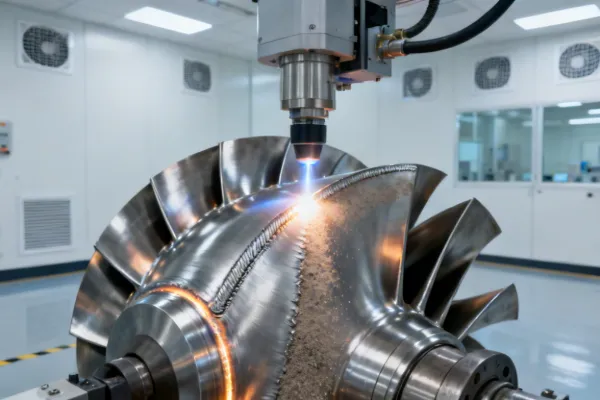
Aerospace manufacturing demands NADCAP-certifiable laser processes with full parameter traceability. Turbine blade tip repair via laser cladding restores Inconel 718 and Waspaloy components to original dimensional specifications, extending blade service life by 3-5 overhaul cycles versus scrapping. Structural welding of titanium alloys (Ti-6Al-4V) for fuselage components requires inert gas shielding and real-time weld pool monitoring to prevent oxygen embrittlement, a capability enabled by fiber laser process heads with integrated sensors.

Key Applications

  • Turbine blade tip repair via laser cladding (Inconel 718, Waspaloy)
  • Titanium fuselage and structural component welding
  • Percussion and trepan drilling of turbine cooling holes
  • Part serialization and MIL-STD-130 compliant marking
Discuss Aerospace Requirements
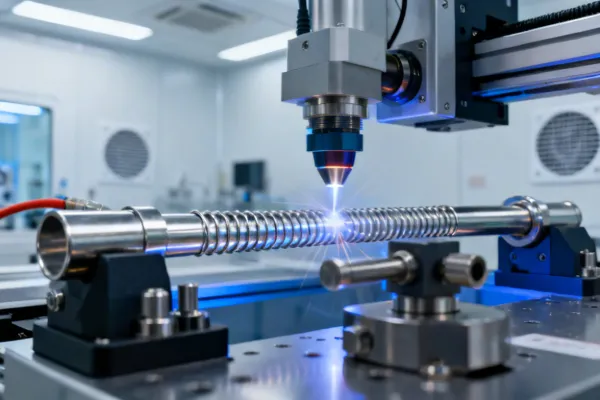
Fiber laser micro-cutting of medical stent
Industry Solution

Medical Devices

Medical device manufacturing operates under FDA 21 CFR Part 820 quality system requirements, where every laser process parameter must be validated and documented. Coronary stent cutting on 316L and L605 cobalt-chromium alloy tubing demands kerf widths under 25 microns with heat-affected zones below 15 microns to preserve biocompatibility. Hermetic sealing of implantable pulse generators (pacemakers, neurostimulators) requires leak rates below 1x10&sup-8; atm-cc/sec helium, achievable through precisely controlled fiber laser micro-welding of titanium enclosures.

Key Applications

  • Coronary and peripheral vascular stent cutting
  • Hermetic sealing of pacemaker and neurostimulator housings
  • UDI-compliant laser marking on surgical instruments
  • Nitinol shape-setting and micro-welding of guidewires
Discuss Medical Device Processing
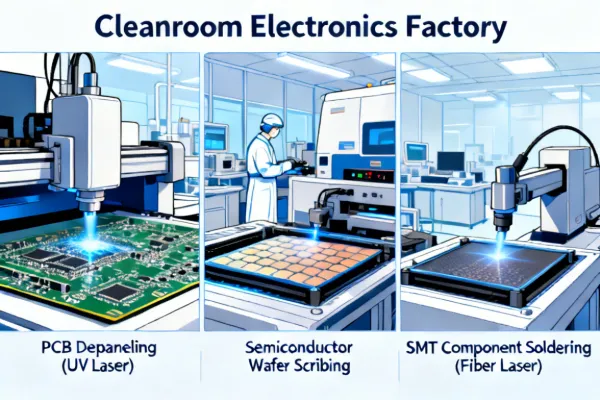
Laser processing in electronics manufacturing
Industry Solution

Electronics & Semiconductors

Electronics manufacturing requires cold-ablation processing capabilities where thermal damage to adjacent components must stay below 50µm. Green (532nm) and UV (355nm) fiber lasers achieve this through short pulse durations (nanosecond to picosecond) that remove material before heat can propagate into the substrate. For PCB depaneling, laser processing eliminates the micro-cracking and dust generation associated with mechanical routing, though processing speed on FR-4 substrates thicker than 1.6mm remains slower than router-based methods, a tradeoff that favors laser processing primarily for high-density flex and rigid-flex assemblies.

Key Applications

  • Rigid and flex PCB depaneling and via drilling
  • Semiconductor wafer scribing and dicing
  • Battery tab welding for consumer electronics and EV cells
  • Selective soldering and micro-joining of SMT components
Discuss Electronics Processing
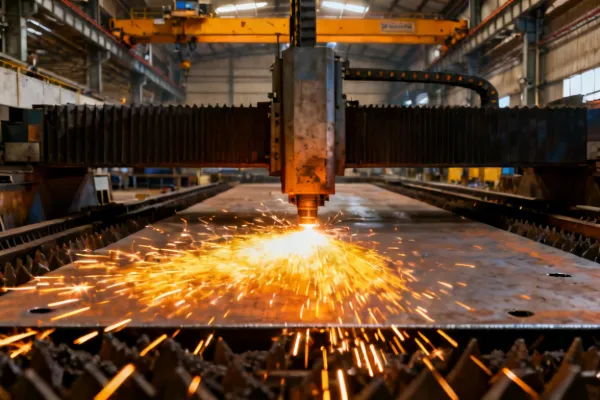
High-power fiber laser cutting thick steel plate
Industry Solution

Heavy Industry

Heavy manufacturing sectors such as shipbuilding and energy infrastructure routinely process steel plates from 20mm to 100mm thick. Multi-kilowatt fiber lasers (15kW to 120kW) have progressively displaced plasma and oxy-fuel cutting for plates up to 50mm, offering narrower kerf widths (0.5-1.5mm vs. 3-5mm for plasma) and tighter dimensional tolerances. Above 50mm thickness, fiber laser cutting remains feasible but edge quality and cutting speed become increasingly sensitive to assist gas parameters, and plasma cutting may still be more cost-effective for non-precision applications.

Key Applications

  • Thick-plate cutting for shipbuilding and structural steel (up to 100mm)
  • Pipeline welding and cladding for oil and gas infrastructure
  • Mining and construction equipment component fabrication
  • Large-scale surface cleaning and coating removal
Discuss Heavy Industry Applications

Application Case Studies

Automotive | EV Battery Welding

BMW Group, Dingolfing Plant (2022)

BMW integrated IPG YLR-3000 fiber lasers into their iX electric vehicle battery module assembly line. The application required welding 192 copper busbar connections per battery pack with a cycle time budget of 45 seconds per module. After 8 months of process validation, the production line achieved a first-pass yield of 99.7% on Cu-to-Cu welds at 2.5kW average power with wobble beam delivery. The fiber laser process replaced ultrasonic welding, which had been limited to 97.2% yield due to tool wear variability on coated copper surfaces.

Shipbuilding | Thick-Plate Cutting

Hyundai Heavy Industries, Ulsan Shipyard (2021)

Hyundai Heavy Industries deployed a 30kW IPG fiber laser cutting system to replace plasma cutting on AH36 marine-grade steel plates ranging from 12mm to 40mm. The fiber laser reduced kerf width from 4.2mm (plasma) to 0.8mm, saving approximately 1.2 tons of steel scrap per ship hull section. Cutting speed on 25mm plate reached 1.8 m/min with nitrogen assist gas at 16 bar pressure. Edge quality met classification society requirements (Lloyd's Register) without secondary machining, though plates above 35mm still required plasma pre-cutting followed by laser finishing for optimal edge quality.

Not Sure Which Solution Fits Your Application?

IPG operates application laboratories on three continents where you can test your specific parts and materials before committing to a system purchase. Submit your application details for a free feasibility assessment.